

Start with your board manufacturer’s target pressure and valve, then choose manual or electric pumping based on how much effort and power you want to carry. An electric pump is useful only when its pressure range, adapters and power source match your exact board and launch plan.
- Use your board manual for its pressure target and limit; do not assume every inflatable SUP uses the same pressure.
- Check the pump’s maximum pressure and gauge or shutoff behavior against the board spec.
- Match the valve adapter and plan the power source before you leave home.
- For several boards, confirm the pump’s stated duty cycle instead of assuming a marketing phrase means unlimited use.
Start with the board’s pressure specification
Find the exact board manual or manufacturer product page and note its recommended inflation pressure and maximum. Those figures belong to the board model, not the paddle-board category as a whole. Choose a pump whose stated pressure range reaches the board’s target, and follow the board maker’s inflation instructions. If the pump page does not publish its maximum, ask before buying rather than guessing.
Choose manual or electric around your trip
- Manual pump. It avoids a battery or vehicle-power requirement, but you do the pumping. It can suit occasional inflation when simplicity matters more than effort.
- Electric pump. It reduces repeated manual pumping, but adds a power source, cable or battery to the setup. Check those requirements along with the pump itself.
Check pressure control, not just the headline number
Compare the pump’s maximum pressure with your board’s target and limit. A gauge helps you follow the intended pressure; an automatic stop or staged cycle can reduce the need to monitor the last part of inflation, but neither removes the need to use the board’s stated target. The NIXY Ventus listing describes a second stage that starts automatically and tops off to a selected PSI. NIXY does not publish the Ventus maximum PSI in the accessible product details, so confirm that figure against your board before choosing it.
Match the valve and adapters
Read the board manual to identify its valve and compare it with the pump’s included nozzle or adapter. NIXY lists seven hose-nozzle attachments with the Ventus, but a count of attachments does not establish a fit for every valve. Check the specific adapter before ordering, especially when the pump will serve more than one inflatable.
Plan where the pump gets its power
An electric model may depend on a vehicle outlet or a separate battery. Make sure that source is available where you launch, and check exactly which leads and battery are included. NIXY’s official gallery shows a 12V DC car connection, while its product page says the rechargeable battery pack is sold separately. The accessible listing does not itemize every power accessory, so confirm the package and power draw before pairing it with a portable battery.
Inflating more than one board
If you are preparing a group, check the pump’s cooling or duty-cycle guidance and ask how many boards it can handle at your expected pressure. NIXY says the Ventus’s Active Cooling technology allows multiple-board inflation, but its accessible product details do not state a board count, session duration or duty-cycle limit. Treat that as a reason to ask about your use, not a guarantee of a particular group size.
A practical buying decision
Choose a manual pump when you want a self-contained setup and accept the effort. Choose an electric pump when repeated inflation is the bigger burden and you can supply the correct power. In either case, hold off if the pump’s maximum pressure, valve fit, or power details are missing and would determine whether it works with your board. The NIXY Ventus is one model to compare; its available information supports its two-stage cycle and seven attachments, while maximum pressure, inflation time and complete power-package contents still need confirmation.
A few good questions.
Is an electric pump always better than a manual SUP pump?
No. An electric pump reduces manual effort but requires a compatible power source. A manual pump avoids that power requirement, so choose based on your trip and tolerance for pumping.
What should I check before buying a SUP pump?
Match the pump’s pressure range to your board’s stated target, verify valve and adapter fit, and confirm the power source and included accessories.
Does the NIXY Ventus include a rechargeable battery?
No. NIXY says its rechargeable battery pack is sold separately. Its official gallery shows a 12V DC car connection; confirm the exact included leads with the seller.
What is the NIXY Ventus’s maximum pressure and inflation time?
Neither number appears in the accessible NIXY product details. Ask NIXY or the seller to confirm them for your board before ordering.
Can the NIXY Ventus inflate several boards in one outing?
NIXY says its Active Cooling technology allows multiple-board inflation, but the accessible product details do not state a board count or session limit. Ask about the number and size of your boards.
Gear that helps.
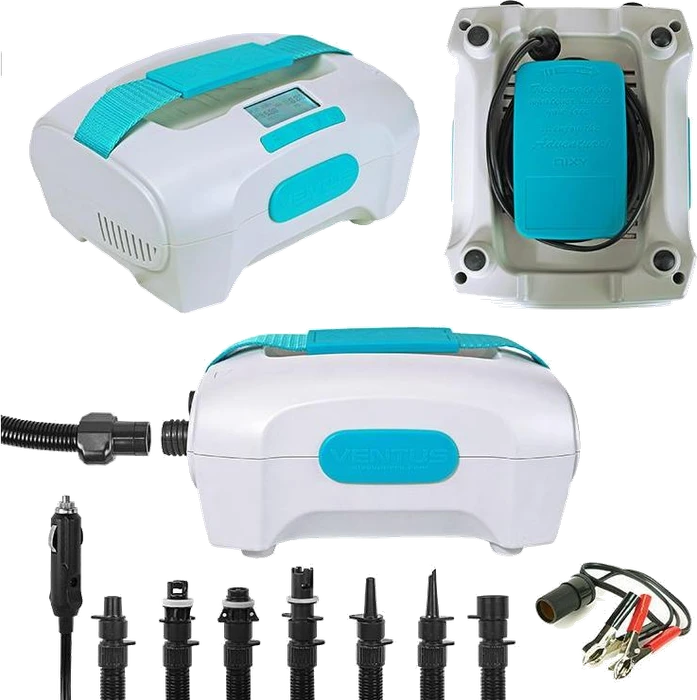
NIXY Ventus Paddle Board Electric Pump
Best forInflatable SUP owners who want set-pressure inflation and valve options for other watercraft
A high-pressure electric pump that inflates in two stages to a selected pressure, with seven nozzle attachments. NIXY says its rechargeable battery pack is sold separately; the accessible listing does not specify maximum pressure or inflation time.
Price today $79.00 · 10% off with the code.
Price checked October 28, 2026 · Backcountry Sportsman US store · Backcountry Sportsman and NIXY listed a $79 sale price and $89 regular price. Their product feeds marked the exact listing available on October 28; tax and shipping are shown at checkout. SEBASTIANBASSOL gives 10% off. Compare the final order total before payment.
Our approach
Written by Outdoor Gear Verdict Editorial. Grounded in NIXY official Ventus product page and Shopify product feed checked October 28, 2026; confirm pressure, valve, and electrical limits against the exact board and pump instructions. Always follow local regulations and the manufacturer instructions for your equipment. Read our editorial standards.