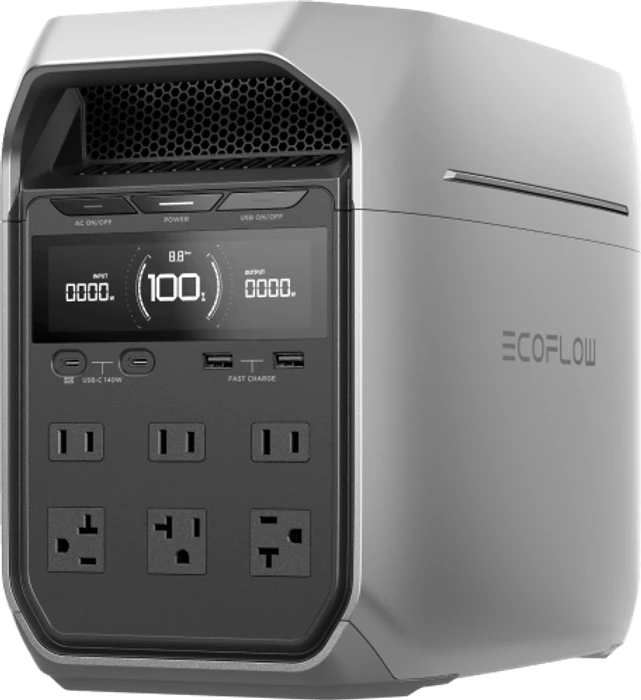
A capable camp power hub.
We recommend the DELTA 3 Plus for car camping and vehicle travel where you want one power station for small appliances and device charging. Its 1,024Wh capacity and 1,800W rated output are a useful pairing. Build a load plan before buying: a high output rating does not mean a high-draw appliance can run all weekend.
What we like
- Useful capacity without a permanent installation
- Room for different charging needs
- Multiple ways to recharge
Keep in mind
- Capacity and output answer different questions
- Plan solar around conditions
The details that matter.
Manufacturer specifications for the configuration reviewed.
- Battery capacity
- 1,024Wh
- Rated AC output
- 1,800W
- Surge output
- 3,600W
- Battery chemistry
- LFP / LiFePO4
- Solar input
- Up to 1,000W
- USB-C
- 2 ports, up to 140W each
Who should put this on the shortlist?
If your camp includes camera batteries, laptops, lights, and a small compressor fridge, a station in this size class deserves a look. The important step is adding up those loads before choosing a model. We like the DELTA 3 Plus as a flexible hub for vehicle-based travel because the published capacity and output suit a broader range of devices than a small USB power bank.
Understanding the headline numbers
Watt-hours describe the energy stored in the battery. Watts describe the rate at which a device uses that energy. For a simple starting estimate, divide capacity by your average load, then allow for conversion losses, standby use, and reserve. A 100W load against 1,024Wh gives 10.24 hours before those reductions. That is arithmetic, not a tested runtime or a promise about a particular appliance.
Buy the system you will use
Check the outlets, your device requirements, and how you will recharge between stops. Solar panels and extra batteries are separate purchasing decisions unless your selected bundle explicitly includes them. EcoFlow sells several DELTA variants and packages, so confirm the DELTA 3 Plus name and US configuration at checkout.
Why we like it.
Useful capacity without a permanent installation
A portable station can move between the vehicle, campsite, and home. The DELTA 3 Plus puts 1,024Wh into that flexible format, making it worth considering before committing to a built-in electrical system.
Room for different charging needs
Two USB-C ports rated up to 140W each are useful for compatible laptops and devices. Use the required cable and device charging standard to make use of those ratings.
Multiple ways to recharge
AC and solar charging support different travel patterns. The published maximum solar input is 1,000W, subject to compatible panels, input limits, and actual conditions.
A few things to consider.
Capacity and output answer different questions
The 1,800W rating describes the rated AC load the inverter can support. The 1,024Wh figure describes stored energy. Heating and cooking loads can consume a large share of that energy quickly.
Plan solar around conditions
Panel nameplate wattage is not a guarantee of charging power. Shade, angle, temperature, and cable or input limits all affect the result.
Get the DELTA 3 Plus.
Vehicle-based camps with a mix of devices. Check the current price and configuration with EcoFlow.
A few good questions.
What is the capacity of the DELTA 3 Plus?
EcoFlow lists 1,024Wh for the standalone DELTA 3 Plus. Bundles with an extra battery have a different total capacity.
Can the DELTA 3 Plus run a camping fridge?
A compatible camping fridge can be a suitable load. Actual runtime depends on the fridge, ambient temperature, settings, cycling, and losses. Measure the fridge’s energy use to size your battery.
Does the DELTA 3 Plus include solar panels?
The standalone product does not imply a solar panel is included. Check the exact bundle contents before ordering.
About this review
Manufacturer specifications and editorial assessment. Product details checked October 15, 2026 against the official EcoFlow product page. Images courtesy of the manufacturer. Our editorial standards.